
How to improve communication in a relationship
"We have a communication problem" is almost never the problem. It is the symptom. Here is what is usually underneath it, and what to do on an ordinary Tuesday.
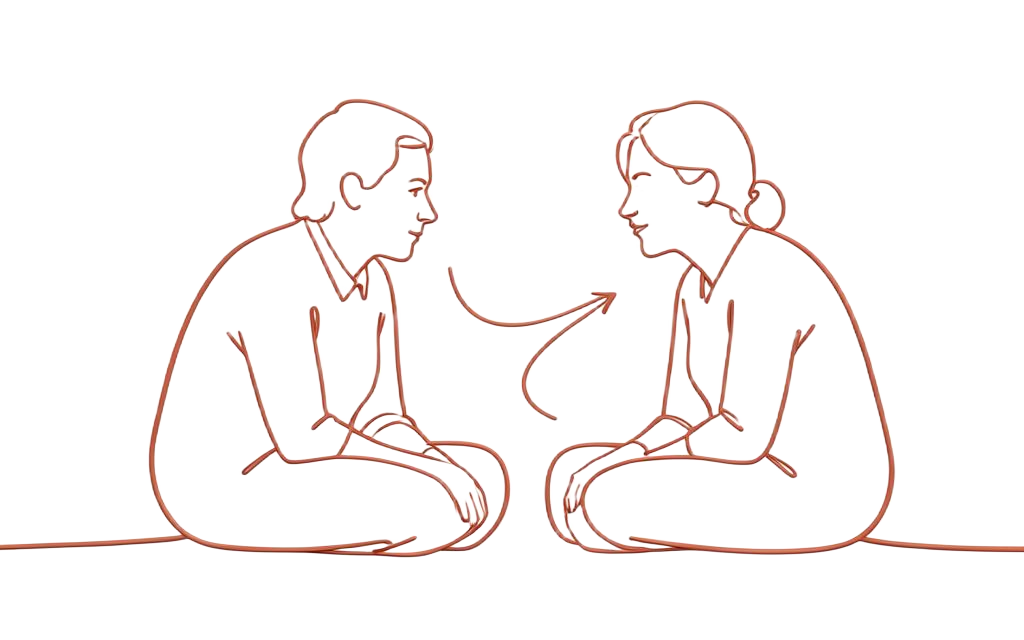
You are probably communicating fine. Just not safely
Most couples I have watched, and my own marriage included, could talk perfectly well. Logistics, work, the children, what is for dinner. What stopped was the risky kind of talking. The kind where you say the thing that might not be received well.
That is not a skills gap. That is a safety gap. Somewhere along the line, saying the true thing started costing more than it was worth, so both of you quietly stopped paying. Fix the cost and the talking comes back on its own.
The four habits that do the damage
Decades of observation research keep landing on the same four. They are worth knowing by name, because you cannot catch yourself doing something you have never named.
- Criticism. Attacking the person instead of the event. "You never think" instead of "the bins did not go out and I am annoyed".
- Contempt. Eye-rolling, mockery, the tone that says you are beneath me. It is the strongest single predictor of separation in the research, and it is the one to cut first.
- Defensiveness. Meeting a complaint with a counter-complaint. It feels like self-protection. It reads as "your experience is not admissible".
- Stonewalling. Going blank and silent. Usually the nervous system flooding, not a punishment — but it lands as abandonment either way.
What to do instead, specifically
Fix the first sentence
The opening minute predicts the rest. Try the shape: when this happened, I felt this, and I would like this. No "you always". No "you never". It sounds mechanical written down. It does not sound mechanical when you say it, and it changes what comes back at you.
Listen without going into repair mode
Active listening is not nodding while you build your rebuttal. It is saying back what you heard, in your own words, before you respond to it. "So it felt like I picked work over you again." Two things happen: they feel met, and half the time you find out you had it wrong.
Name the break instead of vanishing
When you are flooded you cannot think, so nothing said in the next ten minutes will be worth anything. Take the break. But say it out loud: "I need twenty minutes, I am not walking away from this, I will come back at nine." Unannounced silence is the thing that wounds, not the pause.
Make repair attempts and take them
A repair attempt is any small move to lower the temperature mid-fight. A hand on an arm. "Can we start this again." A bad joke. Accepting one when you are still angry is one of the most generous things you will ever do in a relationship, and it is usually the moment the fight ends.
Ask better questions
"How was your day" gets you nothing, because it asks for a summary. "What was the worst twenty minutes of today" gets you an actual person. Specific questions are easier to answer honestly than open ones.
Why the same fight keeps coming back
Because the fight is not about the thing. The dishes, the phone, the mother-in-law, the money — those are the costume. Underneath is usually one sentence: I do not feel respected. I do not feel chosen. I do not feel trusted. Until somebody says the sentence, the argument has to keep returning in new clothes.
So next time it starts, ask yourself what you would need to hear for this to be over. Then say that instead. It is far more exposing than arguing about dishes. That is rather the point.
Give it four weeks, on paper
Pick one habit from this page. One. Do it for a week and write two lines each night about what came back. Then pick the next one. Communication does not improve because you decided it would; it improves because you changed one input and the other person responded to it — or did not, which you also need to know.
Where this advice stops applying
If you are choosing your words to avoid setting somebody off, this is not a communication problem and better phrasing will not help. There is a different page for that.
Common questions
How do I get my partner to open up?
You cannot make anyone open up. You can make it cheap. Ask something specific, listen without fixing, and never use what they said in the next argument. People open up to whoever has proven safe.
Is it possible to over-communicate?
Yes. Endless processing at midnight is not intimacy, it is anxiety with an audience. Short, specific, and in daylight beats long, vague, and exhausted.
We talk constantly and it still feels distant. Why?
Volume is not the measure. Responsiveness is. The question is not how much you say, but whether what you say seems to land somewhere.
Find out which part is actually broken
The free baseline separates respect from repair from trust from intimacy, so you stop guessing which one is causing the rest.
Take the free assessmentOnly have two minutes? Try the quick check-in instead.
Want someone to go through it with you? See the relationship coach plans.
Ready to sit down with someone? Book a coaching session.
New guides, when they land
Leave your email and we will send you each new guide as it goes up. Nothing else, and you can leave the list whenever you want.
We keep your address to send you guides and updates, nothing else, and we never pass it on.